

Handmade vs Machine Made Bags: Which One Fits Your Style?
Beyond the Surface: What Really Sets These Bags Apart
When comparing handmade and machine-made bags, the discussion usually centres on how they are produced. However, the true distinction is found in the philosophy that guides each method. This goes much deeper than hand-stitching versus automated assembly; it's about the fundamental intention behind the bag's creation, which shapes everything from material choice to the final user experience. An artisan often sees each bag as a singular expression, whereas a manufacturer aims for consistent quality across thousands of units. This core contrast leads to two very different definitions of a quality product.
The Artisan's Narrative vs. The Manufacturer's Precision
For an artisan, a bag is a story told through carefully chosen materials and time-honoured techniques. The process is deeply personal, frequently involving skills passed down through generations. This human element isn't a defect but a defining characteristic, embedding a unique personality into every piece. This is especially clear in how materials are treated. For example, certain traditional leather techniques, like hand-burnishing edges, aren't just for looks. They create a seal that allows the leather to develop a rich, individual patina over time—an effect a machine-applied synthetic edge coat cannot match. The subtle variations in a hand-sewn seam often point to a more robust construction, like the saddle stitch, which will not unravel even if one thread breaks.
In contrast, the philosophy of machine manufacturing is built on precision and scalable innovation. While a human hand cannot perfectly replicate an intricate pattern a thousand times, a machine can do so flawlessly. This precision is not about compromising on quality; it's about unlocking design possibilities that are impossible by hand. Computer-guided lasers can carve out complex patterns with perfect accuracy, facilitating modern, minimalist designs that depend on absolute symmetry. This method also supports the use of advanced materials and hardware engineered for specific performance metrics, such as weight distribution and stress resistance, ensuring every bag meets an identical standard of reliability.
The image below shows a collection of traditional leather crafting tools, each designed for a specific manual task.
This setup underscores the deliberate, hands-on nature of artisanal work, where every cut, stitch, and finish is a conscious decision made by the craftsperson.
Cultural Identity and Your Daily Experience
Ultimately, choosing between a handmade and a machine-made bag reflects your personal values and practical needs. A handmade bag often carries a cultural narrative, connecting you to a specific craft tradition or community. Owning one can feel like possessing a piece of art that tells a story. For instance, a bag made with traditional Indian jacquard fabric, such as those from Me Te Amo, links the owner to a rich heritage of textile artistry.
A machine-made bag, on the other hand, aligns with a different set of values: efficiency, modernity, and consistent performance. For a professional who requires a bag that functions reliably day after day, the engineered precision of a manufactured item offers confidence. It is less about the story of its creation and more about how its dependable design supports their own daily narrative. The decision isn't about which is superior, but which philosophy—personal expression or engineered perfection—best fits into your life.
The Craft Behind the Quality: Artisan Skills vs Manufacturing Excellence
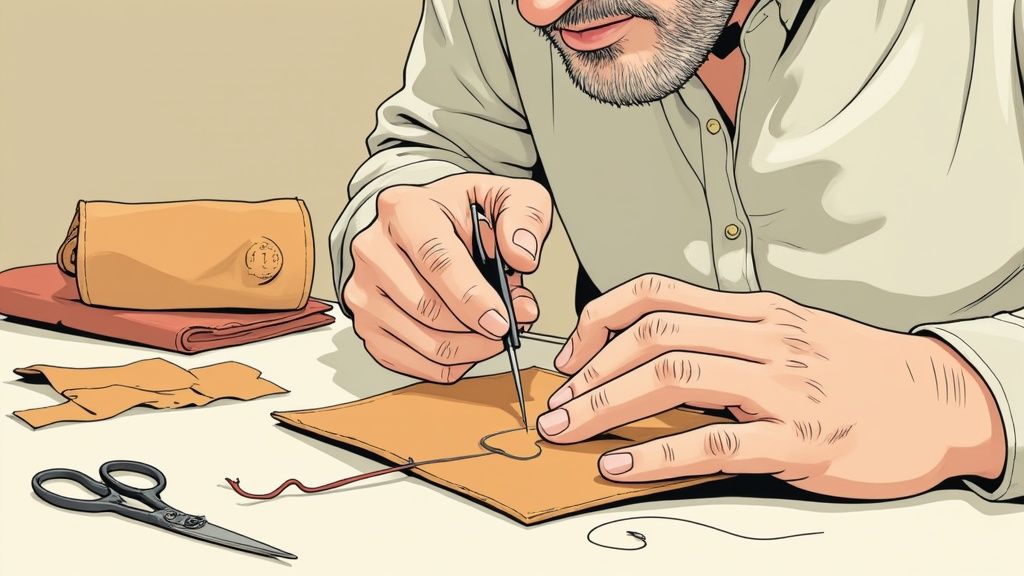
When comparing handmade and machine-made bags, quality isn't a simple either/or proposition. It's a spectrum defined by two different philosophies of excellence. For handmade bags, quality is embedded in the artisan's skill, often developed over many years. This human element introduces unique traits that signal superior construction, setting a masterpiece apart from a lesser item. In contrast, machine manufacturing excellence hinges on precision engineering and systematic quality control, ensuring every bag meets an identical, strict standard. To make a well-rounded decision, it's essential to understand the markers of quality in both approaches.
Identifying Artisan Excellence
The genuine mark of a high-quality handmade bag is found in its fine details, especially the stitching. Many expert artisans employ a saddle stitch, a classic hand-sewing method where two needles pass through the same hole from opposite sides. This creates an exceptionally strong figure-eight lockstitch. Its key advantage is durability; if one thread happens to break, the rest of the seam will not unravel, unlike weaker machine stitches. This is a clear indicator of a bag built for longevity.
Another signal of superior craftsmanship is the finishing on the edges. Artisans frequently hand-burnish leather edges, a painstaking process of rubbing them with a tool to create a smooth, sealed surface. This technique prevents fraying and allows the edge to develop an attractive patina with use. These intentional details are not merely for looks; they are functional signs of a well-made bag designed to endure. To see how these details play out in a specific style, our guide on MK sling bags offers a closer look at pieces known for their craftsmanship.
Understanding Manufacturing Quality
While handmade bags find beauty in unique character, machine-made bags aim for perfection through consistency. Manufacturing excellence is realised through precision quality control (QC) systems. These frameworks involve numerous checkpoints where everything from seam alignment to hardware functionality is rigorously inspected. Lasers might be used to guarantee perfectly symmetrical cuts, while automated stitching delivers absolute uniformity—a crucial element for sleek, minimalist designs.
High-quality machine-made bags also benefit from engineered stress points. Areas that receive the most wear, such as strap attachments and bottom corners, are reinforced using specific stitch patterns and materials designed to withstand daily use without failure. While a machine-produced bag might not have the "soul" of an artisan piece, its quality is proven through its consistent and reliable performance. A well-engineered bag from a reputable brand can certainly become a long-lasting accessory, showing that the production method alone doesn't dictate durability. The focus shifts from the artisan's individual touch to the integrity of the overall design and production process.
This commitment to craft is a vital component of India's economy. Traditional skills like leatherworking and weaving form the backbone of the handmade bag industry, providing livelihoods for millions of artisans in regions like Rajasthan and Uttar Pradesh. These bags are often featured in luxury markets and exported worldwide, a reflection of their exceptional quality and distinctiveness. You can read more by exploring these insights into the Indian luggage and bags market.
The Money Question: Understanding What You're Really Paying For
The price tag on a bag tells only part of its economic story. When deciding between handmade and machine-made bags, analysing the cost structure is crucial for identifying genuine value. The final price reflects more than just materials and labour; it includes production scale, overheads, brand positioning, and the time invested. While it seems logical that handmade bags are always more expensive, this isn't a firm rule, especially when comparing an artisan's creation to a luxury brand's machine-produced item.
Deconstructing the Price Tag
The most significant cost driver for a handmade bag is skilled labour time. An artisan might spend several hours or even days on a single piece, from meticulously cutting patterns to hand-stitching seams. This direct human involvement comes at a premium. For machine-made bags, the major initial investment is in machinery and factory overheads. Once set up, the cost per unit drops significantly due to economies of scale. A machine can produce hundreds of bags in the time it takes an artisan to make one, drastically lowering the labour cost for each item.
The infographic below highlights the sharp contrast in average production time and retail price between the two manufacturing methods.
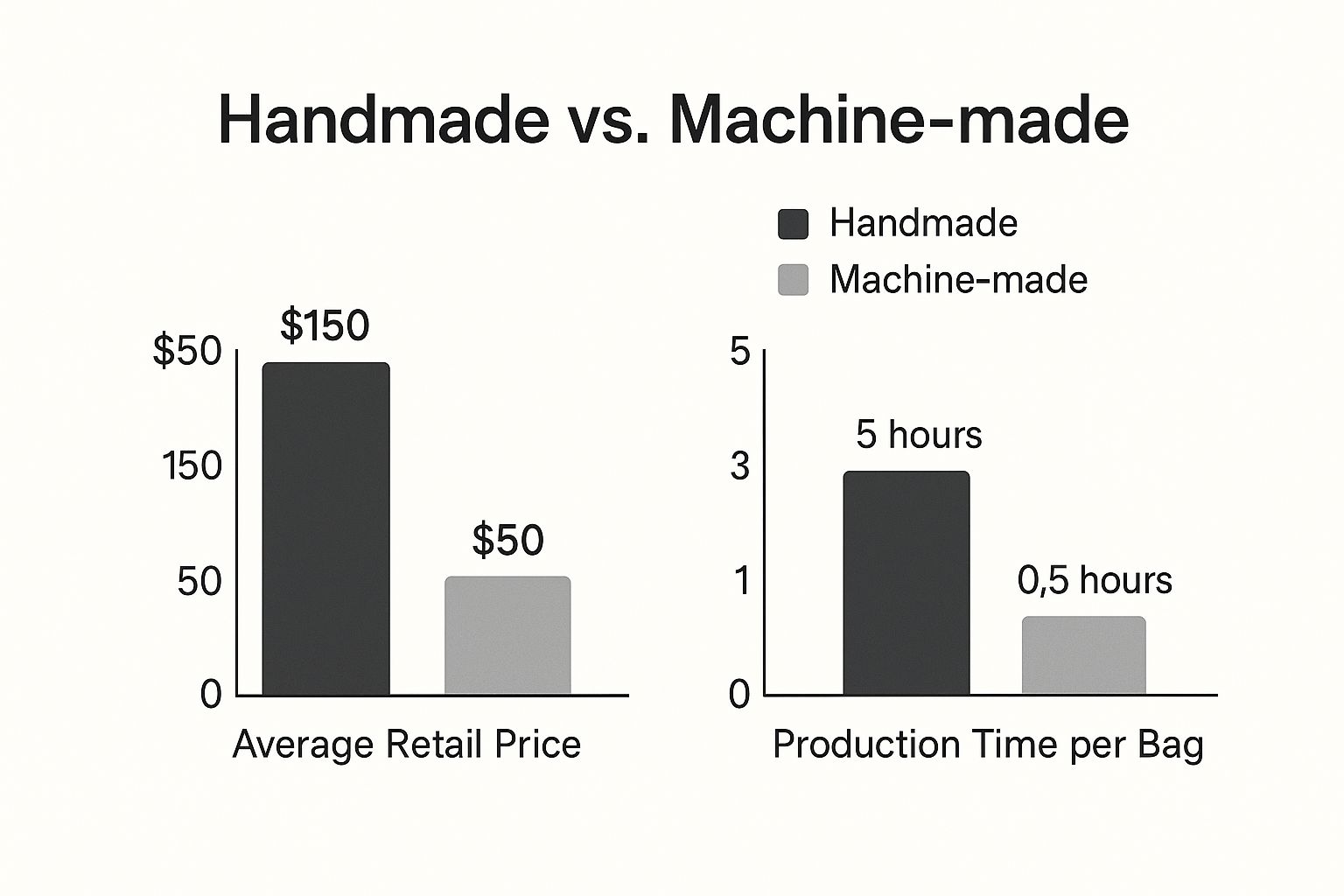
This visual clearly shows that the higher price of handmade bags is directly linked to the extensive time investment, whereas machine production focuses on efficiency to bring down costs.
To help you see how these factors play out in the real world, the table below breaks down the typical price ranges for different types of bags.
Price Comparison: Handmade vs Machine Made Bags by Category
Detailed breakdown of pricing ranges across different bag types and quality levels
| Bag Type | Handmade Price Range | Machine Made Price Range | Value Factors |
|---|---|---|---|
| Leather Tote Bag | ₹5,000 - ₹25,000+ | ₹2,000 - ₹15,000 | Handmade: Full-grain leather, hand-stitching, unique design. Machine Made: Genuine/PU leather, standardised quality, brand name. |
| Canvas Sling Bag | ₹1,500 - ₹5,000 | ₹500 - ₹2,500 | Handmade: Artisan textiles, custom block prints, stronger seams. Machine Made: Mass-produced fabric, faster production, trendy designs. |
| Embroidered Clutch | ₹2,500 - ₹10,000 | ₹800 - ₹4,000 | Handmade: Intricate, manual embroidery, superior materials. Machine Made: Computerised embroidery, quicker turnaround, lower cost. |
| Jute Shopping Bag | ₹400 - ₹1,200 | ₹100 - ₹500 | Handmade: Custom sizes, reinforced handles, ethical sourcing. Machine Made: Bulk production, basic construction, promotional use. |
This comparison shows that while handmade items generally command a higher price, the overlap is significant. A high-end, machine-made designer bag can easily cost more than a simple, handmade artisan tote. The key is understanding what contributes to the final price in each category.
Value Beyond the Initial Cost
A true evaluation of value must consider the total cost of ownership. A low-priced, machine-made bag might seem like a bargain, but if it needs replacing every year, its long-term cost could surpass that of a durable, repairable handmade piece. On the other hand, a high price doesn't automatically mean better quality. Sometimes, you're paying for a brand's huge marketing budget or retail markups, not superior construction. This is where distinguishing between brand prestige and genuine craftsmanship is important. For instance, the transparent pricing of some Van Heusen sling bags offers a different value proposition compared to unique artisanal creations.
The Indian handbags market provides a compelling look at this dynamic. The market is projected to reach approximately US$4.77 billion by 2025, powered by wide-ranging consumer demand. Within this growing market, handmade bags hold a premium niche, prized for their artistry, while mass-produced bags meet the need for affordability and accessibility. You can explore detailed projections about the Indian handbag market's growth on Statista.com to learn more. Ultimately, the best value is found by matching your budget with your priorities—whether that is longevity, unique design, or brand identity.
The Sustainability Reality Check: Environmental Impact Uncovered
When deciding between handmade vs machine-made bags, the question of sustainability is more complex than it first appears. It's easy to assume that small-scale, artisanal production is the greener option. However, when we look at the entire lifecycle—from sourcing materials to the bag's final disposal—the picture becomes much clearer, revealing that both methods have distinct environmental pros and cons. The most sustainable choice often comes down to specific practices, not just the method of production.

This image highlights the key ideas of sustainable fashion, such as responsible resource use and minimising waste. These principles are vital for both handmade and machine-based production. To make a well-informed decision, it's necessary to look past the labels and investigate the real-world impact of each process.
Raw Materials and Processing Impact
The environmental narrative starts with the materials. A handmade bag made from locally sourced, vegetable-tanned leather by an artisan dedicated to reducing waste can possess a very small carbon footprint. This method often sidesteps the harsh chemicals found in industrial chrome tanning, which can contaminate water supplies. However, not every artisan makes sustainable sourcing a priority; some may use materials with a heavy environmental toll without being transparent about it.
On the other hand, large-scale manufacturers are increasingly adopting sustainable practices. They have the financial means to invest in technology like water recycling systems, which significantly cut down on water usage during dyeing and finishing. They might also use certified organic cotton or recycled materials like PET from plastic bottles, achieving sustainability through scale and innovation. A machine-made bag from a brand with a clear, certified supply chain can be a more responsible option than a handmade one from an unverified source.
Energy, Waste, and Transportation Footprint
Looking at the full lifecycle uncovers more trade-offs between the two production methods.
- Energy Consumption: Handmade production typically uses less electricity per item, relying on manual labour. Yet, large manufacturing plants, while energy-intensive, can offset their consumption by investing in renewable energy like solar panels, a choice not usually available to individual artisans.
- Waste Generation: Artisans are often masters of minimising waste. They might use every piece of fabric or leather in a practice known as whole-hide utilisation. In contrast, mass production can create significant amounts of cutting-room waste. However, some progressive manufacturers are now using zero-waste pattern cutting or recycling their textile scraps, transforming a problem into a new resource.
- Transportation: The carbon footprint from transport is a major consideration. Locally crafted handmade bags sold directly have a minimal impact. But many artisanal products are shipped across the globe to find customers. Likewise, machine-made bags are frequently produced in one country and distributed worldwide, racking up substantial transport emissions.
Ultimately, sustainability in the handmade vs machine-made bag debate isn't a given. It requires deliberate action from both producers and consumers. Whether you are looking at versatile black sling bags for women or a sturdy tote, asking about material origins, production waste, and brand ethics is crucial. A responsible manufacturer can easily have a better environmental record than a less-conscious artisan, showing that true sustainability is a choice, not an assumption.
Built to Last: The Truth About Durability and Longevity
When analysing long-term value in the handmade vs machine-made bags discussion, durability is a primary consideration. A common belief is that handmade always means stronger, but this is a misconception. In truth, longevity hinges less on the production method and more on the specific construction techniques, material quality, and stitching used. Both approaches can produce bags that last for decades or fail within months. The crucial skill is knowing what to look for in each type.
A significant indicator of durability in handmade bags is the stitch type. Many artisans prefer the saddle stitch, a labour-intensive technique where two needles pass through the same hole, creating a secure, interlocking thread pattern. The strength of this method lies in its resilience; if one thread breaks, the seam will not unravel. This is a key difference from the standard lockstitch used by most machines, which can come apart completely if a single point fails. This detail is often why a hand-stitched leather bag can withstand decades of use, developing character instead of damage.
Real-World Wear and Repairability
However, machine manufacturing has its own strengths in creating resilient products. High-quality machine-made bags often feature engineered stress points. Areas like strap anchors and base corners are reinforced with specific, high-tensile-strength threads and bar-tack stitching for added strength. This precision ensures that every bag produced can handle consistent, predictable loads without failure. While they may not have the unique character of a saddle stitch, this systematic reinforcement provides a different, yet equally valid, form of durability.
To better understand these structural differences, the table below breaks down the key factors influencing the lifespan and maintenance of both bag types.
Durability Factors: Handmade vs Machine Made Construction
Comparison of key durability indicators and maintenance requirements
| Durability Factor | Handmade Bags | Machine Made Bags | Maintenance Needs |
|---|---|---|---|
| Stitching | Often uses saddle stitch; highly resilient and won't unravel if a thread breaks. | Typically uses lockstitch; uniform but can unravel completely if one thread fails. | Both require occasional cleaning and conditioning, particularly for leather goods. |
| Stress Points | Reinforcement is dependent on the individual artisan's skill and attention to detail. | Often engineered with specific reinforcement techniques like bar tacks for consistency. | Periodically check hardware and seams on both types to catch wear early. |
| Repairability | Highly repairable by skilled craftspeople, but finding an expert can be a challenge. | Repair can be difficult, but standardised replacement parts are often easier to find. | Professional cleaning is recommended for deep stains, regardless of the bag's origin. |
The information in the table shows that neither method is inherently superior; rather, they offer different kinds of structural integrity and repair pathways.
Maximising Lifespan and Making Smart Choices
The ability to repair a bag is just as important as its initial toughness. Handmade bags are generally easier for a skilled leatherworker or tailor to restore. The challenge, however, can be finding a craftsperson with the necessary expertise. Conversely, while a machine-made bag might be harder to stitch by hand, obtaining standardised replacement parts like zippers or clasps is often simpler. For those interested in how popular brands manage this balance, exploring guides on items like Baggit sling bags can provide insight, as they often combine durable elements with accessible design.
Ultimately, maximising your bag's lifespan comes down to proper care. Regular cleaning, conditioning leather, and avoiding overloading it are universal principles. When you're considering a purchase, take a moment to inspect the seams, feel the material, and test the hardware. A well-constructed bag, whether from a meticulous artisan or a high-tech factory, is an investment built to last.
Market Trends and Consumer Behaviour: What's Driving Choices Today
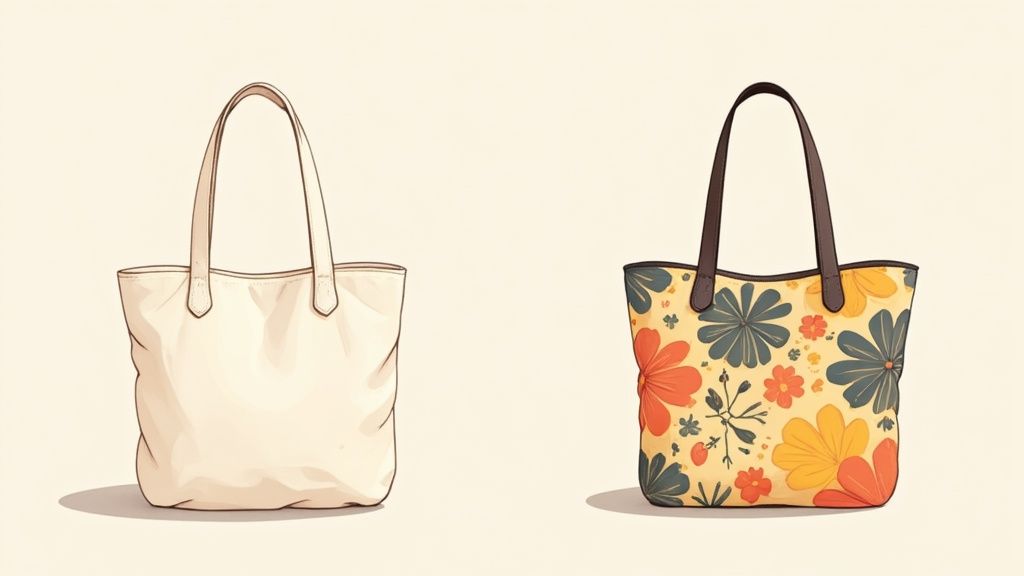
The bag market is currently shaped by a mixture of economic realities, cultural shifts, and changing consumer priorities. To make an informed decision in the handmade vs machine made bags discussion, it helps to understand these forces. A shopper's choice is no longer solely about price; it's also guided by their identity, a desire for authenticity, and what they discover on digital platforms. These factors are creating distinct customer profiles, each with unique reasons for preferring one production method over the other.
Generational Divides and E-commerce's Influence
Different generations clearly have different priorities when buying a bag. Younger consumers, especially Gen Z, often prioritise self-expression and ethical production. They are attracted to the unique story behind a handmade bag, viewing it as a statement piece that shows their individuality and support for artisan work. This generation is very active online, where e-commerce and social media have levelled the playing field, allowing small-scale makers to reach a global audience directly. As a result, a person in Mumbai can now easily buy a macramé bag from a craftsperson in a remote village—a scenario that was difficult to imagine just a decade ago.
On the other hand, demographics like busy urban professionals may value the consistency and reliability that machine manufacturing offers. They look for functional, durable bags that perform as expected every single time. This consumer group is a major force in the mass market. For example, the handbags market in India is expected to grow by USD 1,983.1 million between 2025 and 2029. This expansion is primarily fuelled by machine-made products, which offer standardised quality to a growing urban population that values easy access and affordability. You can find a detailed analysis of these figures in the handbags market forecast on Technavio.com.
Emerging Consumer Segments and Their Motivations
Beyond age, new consumer groups are shaping market directions. Examining their motivations offers a clearer picture of why certain bags become popular.
- The Sustainability-Focused Consumer: This person actively looks for bags made from eco-friendly materials with clear and honest supply chains. They check a brand's ethics, favouring materials like vegetable-tanned leather, recycled textiles, and fair labour standards, regardless of whether the product is from an artisan or a large certified factory.
- The Luxury Seeker: For this buyer, exclusivity is the main goal. While this once meant high-end designer labels, there is now a growing appreciation for custom-made, one-of-a-kind handmade bags. The ultimate form of luxury is owning something unique, which makes artisan creations very attractive.
- The Value-Driven Shopper: This consumer looks at the total cost of ownership. They analyse not just the initial price but also the bag's durability and how easily it can be repaired. They are often prepared to invest more initially in a well-made handmade or high-quality machine-made item if it promises to last longer, delivering better value over its lifetime.
These trends indicate that the decision between handmade and machine-made is becoming more personal. It's guided by individual values, digital accessibility, and specific lifestyle requirements.
Making Your Choice: A Practical Decision Framework
Choosing between handmade and machine-made bags goes beyond features listed on a product page. The real decision hinges on your daily life, budget, and personal values. The "best" bag isn't a universal title; it’s the one that fits your specific context. This framework moves past marketing claims to help you analyse your needs through practical scenarios.
The Professional’s Daily Driver vs. The Stylist’s Statement Piece
Let's compare two distinct users: a management consultant and a fashion enthusiast. The consultant's priority is unwavering reliability. For them, a high-quality, machine-made bag from a trusted brand is often the logical choice. Its engineered stress points, consistent manufacturing, and durable, weather-resistant materials offer dependability. The primary need is function and predictability—assurance that the bag will survive a hectic commute without a single stitch giving way.
Conversely, a fashion blogger or creative professional prioritises uniqueness and personal expression. They choose a handmade bag not just to carry essentials, but to communicate a story. For this user, slight variations in a hand-stitched seam or the distinct grain of artisan-picked leather are celebrated features, not defects. The bag's value lies in its ability to start conversations and act as an extension of their personal brand, making its aesthetic role just as important as its utility.
Assessing Your Priorities: A Situational Checklist
To make an informed choice, you need to weigh what matters most to you in a specific situation. It’s not about which bag is superior overall, but which is better suited for your intended use. This checklist breaks down the decision-making process.
- For Durability Under Daily Stress: If you need a workhorse to carry heavy items like a laptop, documents, and gym gear every day, a well-engineered machine-made bag with reinforced construction is a solid bet. It's built for consistent performance under pressure.
- For Unique Aesthetic and Ethical Connection: If you want an accessory that stands out and reflects a commitment to traditional craft, a handmade piece is the clear winner. This choice directly supports artisan communities and provides a tangible link to the maker.
- For Budget-Conscious Trend Following: When you want to experiment with current styles without a major financial commitment, machine-made bags offer affordable access to fashionable designs. This allows for more frequent updates to your accessory collection.
- For Long-Term Investment and Repairability: If you see a bag as a lasting companion, a high-quality handmade leather bag is a powerful contender. While the upfront cost is higher, its superior materials and construction methods, like saddle stitching, often mean it can be repaired and restored for years of service.
This dynamic is particularly evident in the Indian market, where the demand for luggage and bags is on the rise, especially in urban centres. Machine-made bags hold a dominant market share due to their competitive pricing, making them accessible to a broad audience. In contrast, handmade bags, while representing a smaller volume, frequently command higher export prices, a testament to their artisanal and cultural value. You can find out more by reading the detailed analysis of the Indian luggage market on KenResearch.com. Ultimately, a systematic look at your personal use case is the most effective path to a wise purchase.
At Me Te Amo, we believe in the power of a story. Our handcrafted bags are designed for those who value unique textiles and artisan skill, offering affordable luxury that makes a statement. Discover a bag that tells your story at Me Te Amo today.